We’ve all been there—heart racing at the unknown, FOMO whispering, “What if you miss out?” Yet science whispers back: Curiosity isn’t just a cat-killer; it’s a fear-slayer. Neuroscientists like those at Stanford show curious brains release dopamine, turning dread into delight. When uncertainty looms, fear freezes us. Curiosity? It fuels exploration. But here’s what is reassuring: What if fearing the unknown is the real uncertainty—because curiosity guarantees discovery?
Pause. Recall your last “what if” moment. Did fear win, or did wonder?
Japan’s hikikomori—millions of reclusive youth hiding from life’s chaos. Enter curiosity pioneer Yuval Noah Harari‘s twist: These “withdrawers” sparked ikigai micro-movements, blending isolation with quirky experiments like urban foraging apps. From fear-fueled bunkers emerged global apps teaching resilient living. Flip achieved.
The Fear Tax & The Curiosity Dividend
Fear is a voracious tax on potential. It charges you in advance—with sleepless nights, paralysing over-analysis, and opportunities let slip. Its currency is FOMO, but a twisted version: the Fear Of Making Anything happen. Curiosity, however, pays a dividend. It invests a simple question: “What if this leads somewhere interesting?
The Museum of Failure in Sweden
Instead of fearing public ridicule, it’s creator, Dr. Samuel West, curated a spectacular collection of failed products (Colgate Lasagna, anyone?). By treating flops not with shame but with analytical curiosity, he created a wildly successful exhibit that teaches innovation. The failure became the feature.
Look at the dabbawalas of Mumbai. In the face of urban chaos and logistical uncertainty, their system isn’t built on rigid tech, but on adaptive curiosity—curiosity about shortcuts, human networks, and simple, fail-proof codes. An uncertainty (how to deliver 200,000 lunches flawlessly) met with curiosity created a Harvard-case-study-worthy model.
Introspection :When did you last pay a Fear Tax on a decision? What was the compound interest of worry you incurred?
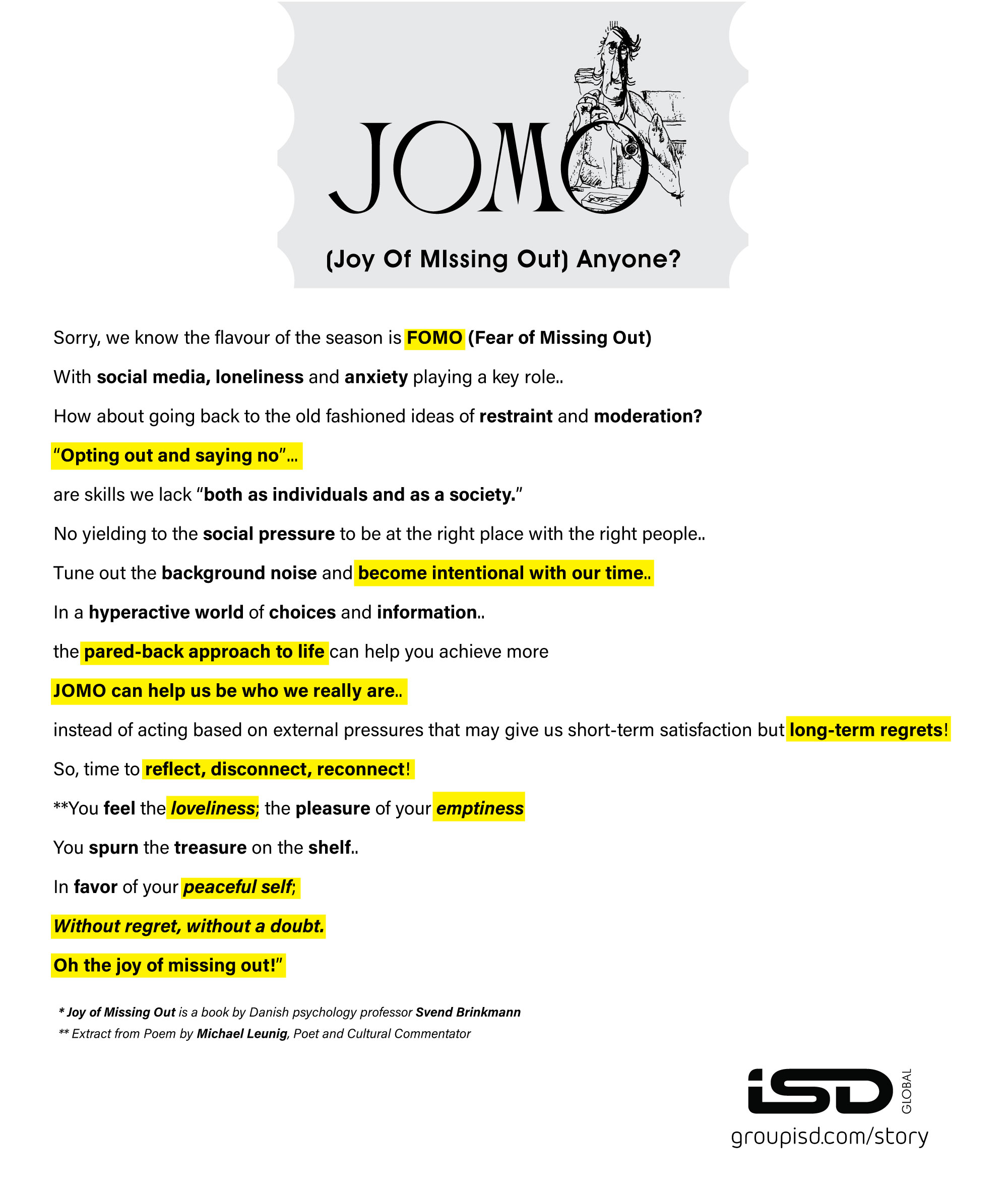
The Antidote to FOMO: JOMO of the Journey
The crushing Fear Of Missing Out stems from a fixation on a single, idealized outcome. Curiosity liberates you by offering the Joy Of Missing Out(JOMO) on predictable, stale narratives. It invites you to miss out on anxiety in exchange for the thrill of discovery. When you are curious, you cannot be bored, and you cannot be victimised by the unknown. You are on a scavenger hunt of your own design.
The Fear Reflex (and Why It’s Overrated)
Fear narrows.
It shrinks timelines.
It pushes us toward familiarity, templates, best practices, consensus.
Fear is excellent for survival.It is terrible for transformation.
When Kodak saw digital photography, fear made them protect film.
When Nokia saw smartphones, fear made them protect hardware.
When Blockbuster saw streaming, fear made them protect stores.
None of these companies lacked intelligence.
They lacked curiosity under pressure.
Fear asks: What do I stand to lose?
Curiosity asks: What might be possible now that the rules are changing?
Only one of these questions has ever built the future. No prizes for guessing which one.
Curiosity: The Most Underrated Strategic Muscle
Curiosity expands time instead of compressing it.
It creates optionality where fear creates dead ends.
Look at Japan’s Shinkansen engineers. When faced with noise complaints from trains exiting tunnels at 300 kmph, they didn’t brute-force the problem. They studied kingfishers. The beak. The dive. The silence. Result: faster trains, less noise, lower energy use.
In India, consider how UPI emerged. The uncertainty wasn’t technological. It was behavioral. Would people trust digital money? Would merchants adapt? Instead of fearing adoption friction, the ecosystem leaned into curiosity. Lightweight apps. QR codes. Zero merchant fees. The result wasn’t just adoption. It was a cultural rewrite of money itself.
Curiosity doesn’t eliminate risk. It reframes it as tuition.
The Inner Shift; Missing The Wood For The Trees
Uncertainty doesn’t demand answers.
It demands posture.
Fear-based posture says: “Tell me what to do.”
Curiosity-based posture says: “Let me explore what’s unfolding.”
This is where leadership quietly diverges.
The most effective leaders today are not the ones with certainty.They are the ones comfortable holding questions longer than others.
They don’t rush to close the loop.
They widen it.
They understand that clarity is not the starting point.
It is the byproduct of engagement.
The Quiet Payoff
When you meet uncertainty with curiosity:
• You see patterns others miss
• You build anti-fragility, not just resilience
• You stop playing defense against the future
• You become interesting again, to yourself and to others
Most importantly, you stop outsourcing your sense of agency to circumstances.
The future doesn’t reward those who wait for certainty.
It rewards those who know how to dance with ambiguity without needing guarantees.
Uncertainty is not asking you to panic. It’s asking you to participate.
In Closing
The truth about uncertainty: It’s not a bug in the system. It’s the feature that keeps life from becoming a rerun.
So the next time you feel that familiar knot in your stomach when facing the unknown, pause. Take a breath. And ask yourself the most powerful question in the human arsenal:
“I wonder what happens next?”
That’s not just optimism. That’s strategy.